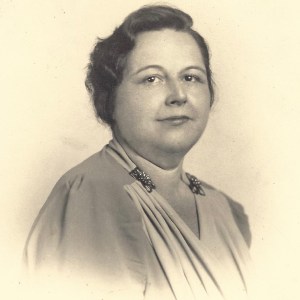
Today I’m going to take you back, waaaaay back. The year is 1927 in a small but thriving railroad town southwest of Richmond called Victoria. The Millican family lived in Victoria. Reva and Claude Millican had seven children ranging in age from two to 13 years old: Glenn was the oldest, then Nina, Clyde, who was born with the cord wrapped around his neck and suffered mild brain damage, Billy, Phillip, Iris, and the youngest, Shirley, who later became my mother. Also, Reva was pregnant with twins. The house was small, two bedrooms for a family of nine. That’s right, TWO bedrooms for a family of NINE. They were a very close-knit family, aside from the obvious reasons, because they didn’t have very much in this world except for each other. Claude owned a trucking company, which delivered products that came into Victoria via train from Richmond out to the rest of Lunenburg County. But with such a large family, you can imagine, it was hard to make ends meet. One week before Christmas, on December 18, 1927, Reva went into labor. Her regular doctor was out of town for the holidays and so another doctor was called to the house to deliver the twins. Unfortunately, Reva began to hemorrhage and neither she nor the babies survived, a fact that Claude would forever blame on the doctor who was not familiar with Reva. The reality is if Reva had been in a hospital and Caesarean sections were as common as they are today, Reva most likely would have survived. But in 1927 it would have been a miraculous feat of medicine.
Claude was heartbroken, angry about losing the love of his life, and a single father of seven children with a business that had him traveling frequently. His younger sister, Mary, who was 22 years old and engaged to be married, agreed, along with her fiancé, that they would take the youngest to raise. That was my mother, Shirley, who was two at the time. Mary came to take Shirley as soon as possible, even though she wasn’t married yet, in order to help her brother. She and her fiancé, Grady Henry, who was a World War I veteran and a barber, went to the tiny house to pick Shirley up. Mary packed up the baby’s stuff, as all the other children gathered around, anxious, sad, and begging for Shirley to be left with the rest of the family. As Mary and Grady were leaving, the six other siblings sat looking out of the window crying as they waved goodbye to their little sister. And Mary’s heart broke. She couldn’t do it. She couldn’t split up these children who had just lost their mother and now were getting ready to lose their youngest sister. She told Grady, “I can’t do it. If I take one of them, then I have to take them all. I just can’t break these children any more than they have already been broken.” So, Mary called off her engagement to Grady and moved into her brother’s house to help raise his seven children. He was very grateful and gave Mary one of the two bedrooms. The other bedroom was for the girls. Claude and the boys slept in the unfinished attic of the house. I’d just like to imagine this scenario today. Imagine that you’re 22 years old, engaged to be married, and deciding to give it all up to help raise your older brother’s children, seven children at that. But this is the incredible story of how Mary became my grandmother.
Mary was not like any 22 year-old I’ve ever known. She moved in and became a surrogate mother to her nieces and nephews. They called her Mame and she was the center of their universe and ruler of the kingdom. And she ruled with an iron fist, or ivory hairbrush from what I’ve been told. But she loved those kids like they were her own and protected them like a lioness protects her cubs. When my mother, Shirley, was a little girl there was an outbreak of Scarlet Fever. Scarlet Fever was highly contagious and, at the time, the majority of children who contracted this illness did not survive. If they did survive a lot of them developed long-term damage, such as kidney or liver damage. If you have read Little Women, Meg suffered the long-term damage of Scarlet Fever. Shirley was put in quarantine away from the rest of her siblings and Mary was the only person to care for her. Against the odds, she nursed her back to health without passing the illness on to any of the other kids. However, once she was better the doctor said all of the sheets, towels, toys, etc. that Shirley had had with her in quarantine had to be burned so as not to spread the infection. If you have ever read the Velveteen Rabbit this scenario may sound familiar. Shirley had kept her doll with her while she was sick, the one and only doll she owned. And when the doctor said the doll would have to be burned my mother was devastated. So Mary took the doll and washed her in kerosene several times to kill the Scarlet Fever germs. She hung her on the clothesline and let her dry out for several days. Then she washed the kerosene out and hung her again on the clothesline until she was completely dry before giving the baby doll back to Shirley. The family did not have much and this doll meant the world to Shirley. And the fact that Mary had saved her doll meant even more to her.
Mary was a very skilled seamstress and took in sewing jobs to make extra money for the family. She made all of the children’s clothes herself. She could smock a dress more beautifully than any machine is able to today. She would make dresses for the girls that were so pretty that others in the neighborhood would ask her to make the same dress for their daughter. She would decline their offers. They were one of the poorest families in town and she wanted to reserve some things just for her children so they didn’t feel like complete outcasts. So if her girls had dresses that were lovelier, or at least just as lovely, as the other girls then they could keep some semblance of pride. She was also a talented cook and especially brilliant at baking. Apparently her caramel cakes were world famous…Okay, they were “Victoria” famous, and all the kids begged for one for their birthday.
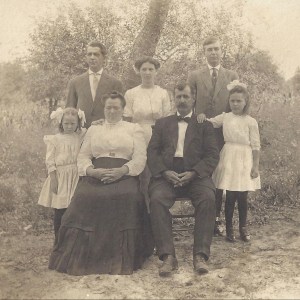
As I mentioned before, when Clyde, the third sibling, was born the umbilical cord was wrapped around his neck. So oxygen was cut off to his brain for enough time that he had some brain damage, therefore he had intellectual disabilities all of his life. Of course, let’s remember he was born in 1917. He was ten years old when Mary took over as their mother figure. The philosophy at the time was that children with Clyde’s extent of disability should be institutionalized. That was not the philosophy in the Millican household. Mary made sure that Clyde was allowed to continue in the local public school for as long as he was able to keep up, even if he was several years older than his classmates. Mary said she didn’t care; he was going to get as much education as his brain was able to absorb. He was held to the same standards as everyone else in the house as far as chores and responsibilities, personal hygiene and grooming, manners and etiquette. And Mary set these standards high for everyone.



She had to set high standards. The truth is she was the main caretaker, disciplinarian, nurse, accountant, nutritionist, etc. for a brood of seven children. On top of everything, the stock market crashed in 1929, just shy of two years into her role as mother, and thus the Great Depression began. Claude spent most of his waking hours working to provide for his large family. There had to be boundaries and discipline otherwise there would have been total chaos. But there was also love and laughter and family was always the most important concern in their lives. Claude and Mary had a sister, Hazel, who also lived in Victoria and had two daughters that were about the same ages of Shirley and Iris. And though they were cousins they were so close growing up that they called each other sisters. Even as adults our families remained close.
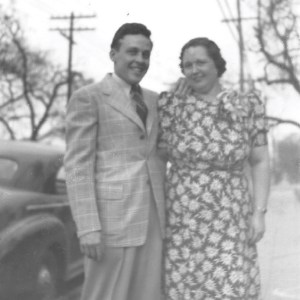
When the U.S. entered World War II, Mary moved with Iris, who had graduated high school, to Alexandria, Virginia so Iris could join the war effort by working at the torpedo factory that was built on the river there. The boys were all out of high school and either working or had joined the military. My mother, Shirley was graduating high school soon and was then moving to Alexandria also. Always wanting to be a nurse, she would enter the Cadet Nursing Corps. One day while Mary was walking down King Street in Old Town Alexandria she came upon a barbershop called “Grady’s Barbershop.” Thinking this might be either coincidence or fate, she stepped inside to find out which scenario it actually was. There she found Grady, the man she had been engaged to years before. He had been married and had two daughters, Leah and Amber, but was divorced and had custody of his two daughters. And so 16 years later, fate brought them together, and they finally were married on December 1, 1941. Mary found herself as surrogate mother to two more children, as she helped Grady continue to raise Amber and Leah.
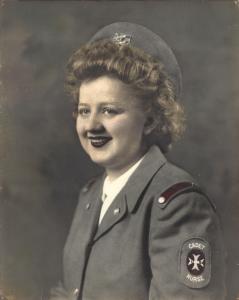
My mother moved to Alexandria in 1943 and became an RN through the Cadet Nursing program. After World War II she lived with Mary and Grady for 20 years while she worked the night shift at Alexandria Hospital. In the 1950’s Mary had a massive stroke and was paralyzed on her right side. She could only get around with a walker and even then she needed help. So my mother helped to care for her. And even after my mother and father were married, my mom continued to go to Mary’s house everyday to make sure she was bathed and there was food and to clean the house. When she fell and broke her hip in 1973 it was decided that Mary would have to move into a nursing home because her house was just not suited for a wheelchair and she needed the daily medical attention that she would receive in a skilled nursing home. I was five years old then. When I was born she had already had her stroke so therefore I was really the only person who could pretty much understand most of what she said since the stroke had impaired her speech. However, the stroke never impaired her curse words, which she would tend to use frequently when frustrated by people not being able to understand her. This always delighted me and sent me into fits of giggles. My mother went to the nursing home twice a day during the school year, since it was right down the street from my school. She went in the morning after she dropped me off and then again in the afternoon after she picked me up. During the summer we went once a day, but we went everyday. I loved my grandmother with all my heart. Not surprisingly, she was like another mother. But she spoiled me rotten, letting me get away with way more, I’m sure, than she ever would have let anyone else get away with. For example, Grandma didn’t like black licorice. Every Easter I’d play this game with her where I’d say, “Close your eyes and open your mouth and I’ll give you a big surprise!” She’d say, “No black ones!” Then I’d put a jellybean or chocolate into her mouth. But every so often I’d toss in a licorice jellybean. That would make her sputter and curse, which just tickled me. But she would continue to let me play the game, knowing that eventually I was going to give her another licorice.


My mom was 43 when I was born in 1968. And to her generation jeans were not dignified to wear out in public. When she was growing up you only wore jeans while doing manual labor, and even then men were really the only people to wear them. My mother wouldn’t let me have a pair of jeans even though I begged for them. So when my tenth birthday was coming around my mother asked Grandma what she wanted to get me for my birthday. And Mary had my back. She told my mom she wanted to get me a pair of jeans for my birthday. What was my mom to do? She certainly couldn’t tell Mary no. That was in November 1978, right before she died. At the age of ten I finally got my first pair of jeans thanks to my grandmother. She was still trying to make sure the children she loved didn’t feel shunned or rejected. And therefore, my mother never wanted this woman to feel alone in this world, since she had given so much to and for their family. My mom and I continued to visit her everyday until she passed away December 11, 1978. And we were with her then as that strong, loving, selfless woman left this world to move on to the next.

 Moonsister
What a story of a beautiful woman. Thank you for sharing this!!
LikeLiked by 1 person
Thank you so much, Amelia. She truly was an inspiration! I’m glad you enjoyed.
LikeLike